Dr. Kaproth's Research Projects
 The Kaproth Lab investigates how plant species adapt and spread across environments.
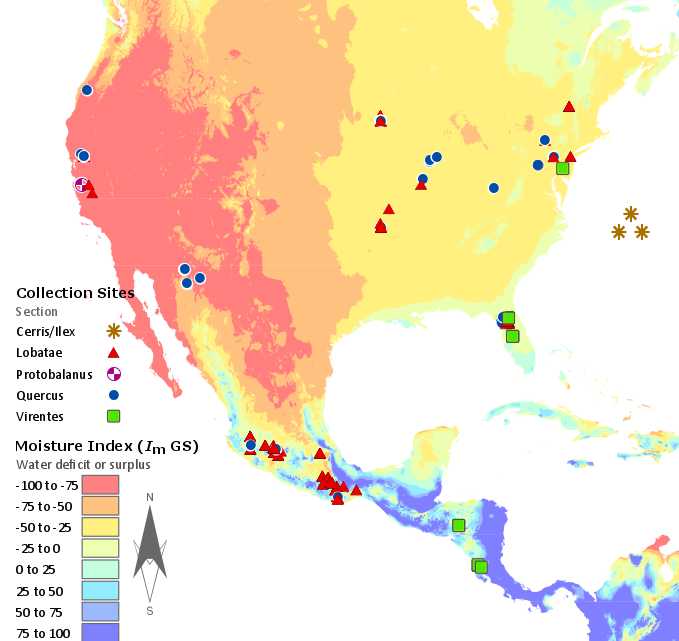
We tend to focus on maples and oaks as a model systems - the later of which are the most diverse and abundant woody genera in the United States and Mexico. Past work shows these North American species diversified from a common ancestor and converged on drought adaptataion patterns.
Plant systems allow us to investigate fundamental ecological processes driving species success and providing practical applications for species management. I am especially interested in focusing on plant drought tolerance, functional trait adaptation, the interaction of soil and plants, as well as invasive species biology. My lab uses common gardens, herbarium collections, Geographical Information Systems (GIS), along with lab and field measurements to investigate the evolution of stress tolerance (and suites of additional traits) across the Americas.
The Kaproth Lab works with a team of collaborators. We have conducted systematics and demographic studies in widespread plant systems (oaks and maples), rare plant systems (prairie) and invasive plant systems (such as reed canarygrass, Phalaris arundinacea and tree-of-heaven, Ailanthus altissima).
Areas of interest:
- Botany / Ecology / Ecophysiology
- Systematics / Trait variation and adaptation / Drought tolerance
- Invasive species
- Plant conservation / Prairies & Savanna
- Population biology & dispersal
- Environmental science
- Remote sensing & GIS
- Environmental policy
Lab MEMBERS aND CURRENT PROJECTS
Recruitment:
For 2026 & 2027, the Kaproth Lab is unable to support additional graduate students.
For current Minnesota State University undergraduate students, the lab may be able to support you (to help work on ongoing projects with other lab members). Please reach out directly to those lab members or to Dr. Kaproth via email. Be sure to describe what you are interested in (what you hope to learn) and include your resume/CV.